


If you’re running a business in 2026, you already know that "business as usual" is a thing of the past when it comes to energy. Between the ongoing volatility in global markets: often spurred by geopolitical tensions in the Middle East: and the ever-shifting Ofgem price caps, electricity costs have become a volatile line item on your P&L.
Recent Cornwall Insight forecasts suggest that many businesses could face an average bill increase of over £332 per month, bringing average annual costs for some SME operations toward the £1,973 mark or higher. It’s enough to make any finance director lose sleep. But here is the good news: you have more control over your energy future than you might think.
Switching to business solar power isn't just a "green" PR move anymore; it's a cold, hard financial strategy. In this guide, we’re going to walk you through exactly how to forecast your commercial ROI and, more importantly, how to keep those running costs as low as possible.
Why Business Solar Power is a Financial Shield
For a long time, solar was seen as a luxury or an experimental addition for eco-conscious brands. Today, it’s a hedge against inflation. When you generate your own power, you are essentially "buying" 25 years of electricity at today's prices: and then seeing the cost of that power drop to near zero once the system is paid off.
We understand if you're scratching your head at the complexity of commercial energy contracts. The market is dense. But when you look at the numbers, the argument for solar becomes clear. Unlike the stock market, which can swing wildly based on a single news cycle, the sun’s output is remarkably predictable.
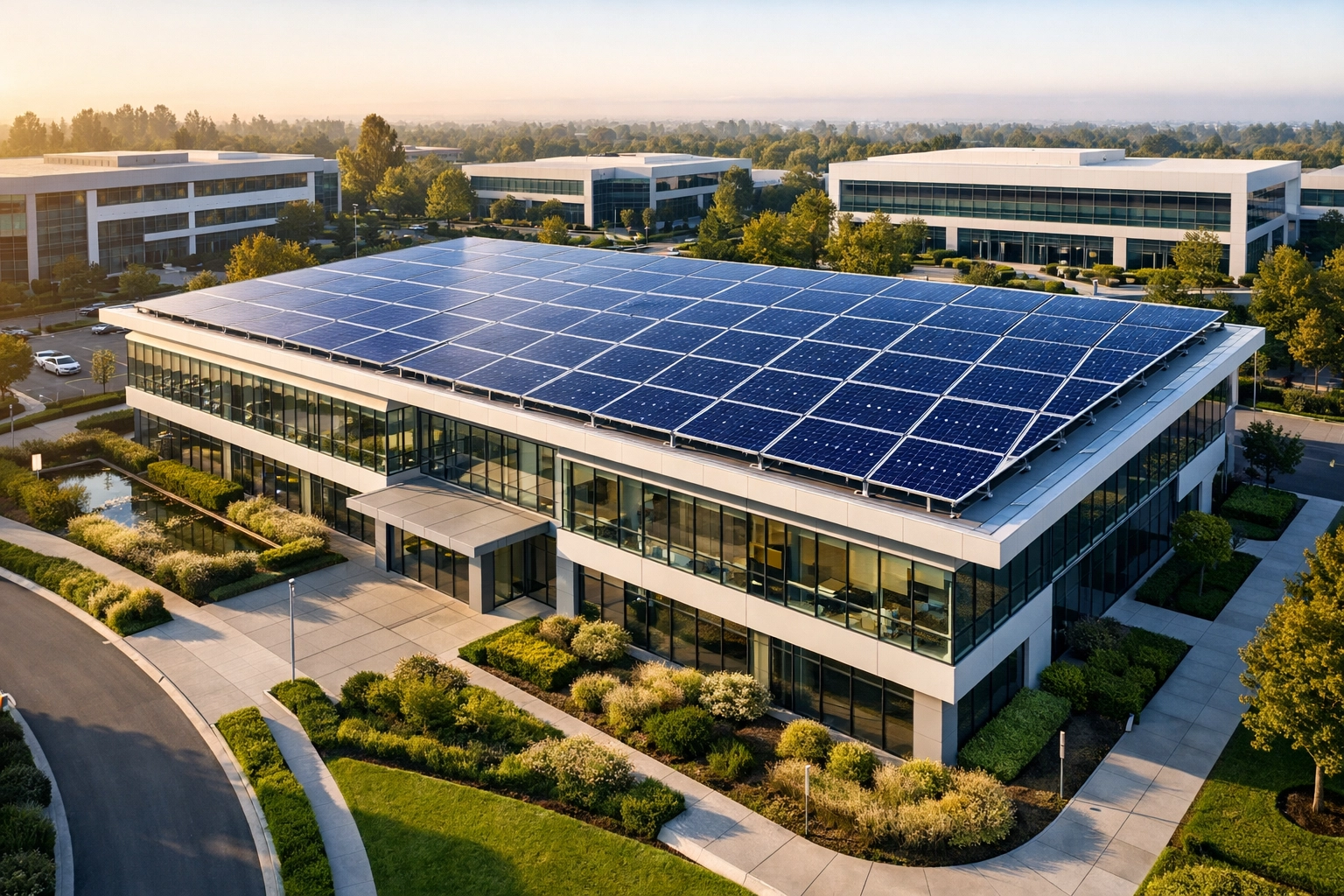
The Honest Advantages and Disadvantages of Solar Power
We believe in transparency. If we told you solar was a perfect, flaw-free solution for every single business, we wouldn't be doing our job. Every investment has two sides, and it's important to weigh the advantages and disadvantages of solar power before you sign a contract.
The Advantages
- Predictable Energy Costs: You lock in your energy rate for the next two to three decades.
- Tax Efficiency: Between the 30% Investment Tax Credit (ITC) and accelerated depreciation, the government is essentially subsidising your transition to clean energy.
- Increased Property Value: Commercial buildings with solar installations are often more attractive to buyers and tenants who are looking to avoid high utility overheads.
- Carbon Footprint Reduction: Meeting ESG (Environmental, Social, and Governance) targets is becoming a requirement for many B2B contracts.
The Disadvantages
- Upfront Capital: Even with falling prices, the initial investment is significant. And that's okay: there are financing options, but it’s a commitment.
- Intermittency: The sun doesn't shine at 2 AM. If your business runs 24/7, you’ll need to consider battery storage or remain reliant on the grid during off-hours.
- Roof Suitability: Not every roof is ready for panels. If your roof is old or structurally weak, you might face extra costs for reinforcement.
- Weather Dependence: While UK panels are designed for our climate, a particularly gloomy month will result in lower yields than a blazing July.
How to Forecast Your Commercial ROI
Calculating the Return on Investment (ROI) for a commercial system is a bit more involved than for a residential one, but it follows the same basic logic. Most businesses we work with see an average ROI of around 15.87%, which significantly outperforms traditional low-risk investments.
Here is how you can forecast your own numbers:
Step 1: Calculate Your Net Investment
Take the gross cost of the installation and subtract all immediate incentives. If a system costs £100,000, but you claim the 30% tax credit and benefit from capital allowance schemes, your "true" out-of-pocket cost is much lower.
Step 2: Estimate Annual Energy Savings
Look at your current electricity bills. How many kWh do you use during daylight hours? If your solar system produces 50,000 kWh a year and you use all of it, you multiply that by your current utility rate (e.g., £0.25/kWh). That’s £12,500 in year-one savings.
Step 3: Account for Inflation
Utility companies rarely lower their prices for long. When forecasting ROI, we typically factor in a 3-5% annual increase in grid electricity costs. This means your solar panels actually become more valuable every year.
Step 4: Factor in Maintenance
While solar panels have no moving parts, they aren't totally "set and forget." You should budget a small amount (usually less than 1% of the system cost) for annual inspections and cleaning.
| Metric | Average Performance | Top Tier Potential |
|---|---|---|
| Annual ROI | 15.87% | 20% + |
| Payback Period | 9.05 Years | 5 – 6 Years |
| System Lifespan | 25 – 30 Years | 30 Years + |
| Typical Monthly Saving | 30% – 50% | Up to 80% |
If these numbers look promising, you might want to explore our solar panel investment advice for a deeper dive into the specifics of commercial financing.
Variables That Shape Your Returns
No two businesses are identical, and several factors will dictate whether you hit a 5-year or a 10-year payback period.
Solar Irradiance and Location
It sounds obvious, but your geographic location matters. A warehouse in the south of England will naturally generate more power than one in the north, simply due to the angle and duration of sunlight. However, even in the north, the high cost of grid electricity often makes solar a viable financial choice.
Shading and Orientation
If your roof is shaded by nearby trees or taller office buildings, your efficiency will drop. We use 3D modeling to simulate exactly how much sun your specific roof will get throughout the year. If you have a south-facing roof with zero obstructions, you’re in the "goldilocks zone" for ROI.
System Size and Efficiency
Over-sizing a system can actually hurt your ROI if you aren't being paid a fair rate for the excess energy you export back to the grid. The goal is to "right-size" the system to match your peak daytime demand.
Strategies to Cut Running Costs
Once your panels are on the roof, the goal shifts from "installation" to "optimisation." How do you ensure every ray of sunshine translates to a lower bill?
1. Front-Load Your Benefits
Work with your accountant to take advantage of accelerated depreciation. In the UK, schemes like the "Full Expensing" capital allowance can allow you to write off the cost of the investment against your taxable profits in the very first year. This provides a massive cash-flow boost right when you need it most.
2. Monitor Performance Regularly
You can’t fix what you can’t see. Most modern commercial inverters come with sophisticated monitoring software. If one string of panels is underperforming due to a build-up of dust or a technical fault, you need to know immediately.
3. Smart Maintenance
Don't wait for something to break. Routine cleaning (especially if your business is near a dusty industrial park or the coast) can improve yields by 5-10%. We recommend a professional check-up once a year to ensure your electrical connections remain tight and efficient. You can find more on this in our solar installation and maintenance section.
4. Adjust Your Operational Habits
If possible, shift energy-intensive processes to the middle of the day. If you run a manufacturing plant, can you schedule your heaviest machinery to run between 11 AM and 3 PM? By "self-consuming" your solar power rather than exporting it, you save the full retail price of electricity.

Real-World Impact: The 25-Year Outlook
Let's look at the long game. Most commercial solar panels are warrantied for 25 years, but many continue to produce power at 80% efficiency well into their 30th year.
After your payback period (let's say 9 years), you have 16+ years of essentially free electricity. For a medium-sized enterprise, this can result in cumulative savings of hundreds of thousands of pounds. In a world where margins are thin and competition is high, having significantly lower overheads than your competitors is a massive strategic advantage.
Between you and our team, we can figure out if your building is a candidate for these kinds of returns. It starts with a simple conversation about your current energy usage.
Taking the Next Step
Forecasting ROI can feel like a daunting task, especially with the current state of the energy market and the complexity of commercial tax incentives. But you don't have to do it alone.
At DES Renewable Energy Ltd, we specialise in helping businesses turn their unused roof space into a high-performing financial asset. Whether you're just starting to look at the advantages and disadvantages of solar power or you're ready to see a full technical proposal, we're here to guide you.
Why not see what the numbers look like for your specific site? Contact us to discuss your needs or request a bespoke solar quote today. We’ll help you crunch the numbers, navigate the incentives, and build a more resilient future for your business.