


What “solar power” actually means for you in Poole
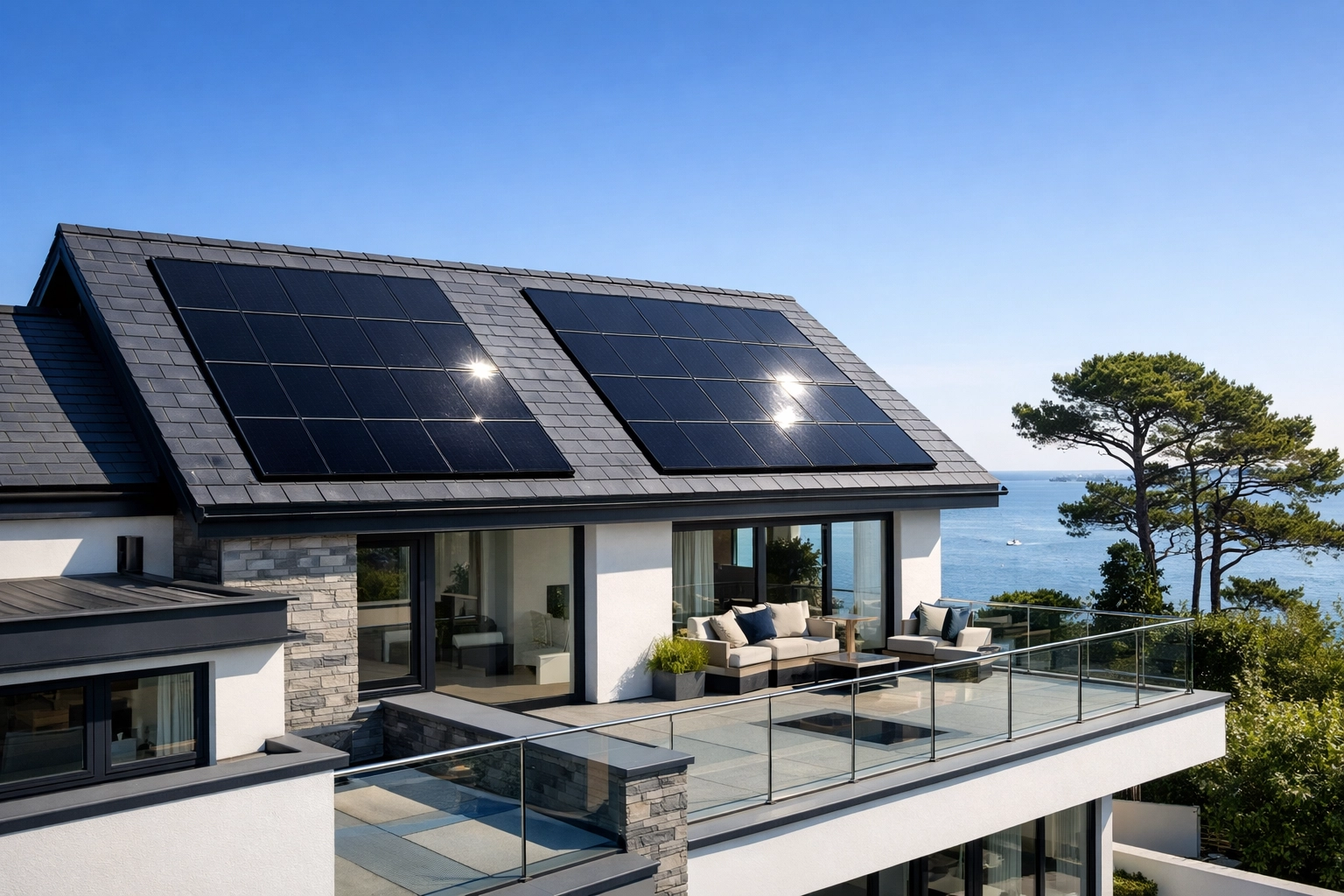
When people say “going solar”, they usually mean Solar PV (photovoltaic) panels on your roof that turn daylight into electricity you can use in your home or business.
And yes, Poole isn’t Spain. You’ll still generate meaningful power here, but your output will swing by season. That’s normal, and that’s OK.
Here’s the simple flow:
- Panels generate electricity during daylight
- Your building uses that electricity first (this is where most savings come from)
- Any spare can be exported to the grid (you may be paid via an export tariff)
- At night you import from the grid, unless you also have a battery
The advantages and disadvantages of solar power (quick comparison)
If you just want the straight answer before the detail, this table is for you.
| Topic | Advantage | Disadvantage (the honest bit) | What usually fixes/helps |
|---|---|---|---|
| Bills | Lower electricity bills by using your own power | Savings vary, usage patterns matter | Design around your daytime demand; add battery if it fits |
| Payback | Often 7–12 years in the UK (typical homes), sometimes quicker for businesses | Upfront cost can feel steep | Finance options, smart sizing, staged upgrades |
| Independence | Less exposure to price rises | Still grid-tied unless you add storage | Battery + smart tariffs |
| Environment | Lower carbon footprint | Panels have embodied carbon from manufacturing | Long lifespan (25–30+ years) offsets this |
| Maintenance | Minimal moving parts | Inverter may need replacing | Plan for inverter lifecycle; annual check |
| Roof | Uses unused roof space | Not every roof is suitable (shade, age, orientation) | Survey + alternative layouts (e.g., split arrays) |
Advantage #1: Lower electricity bills (and why it’s not “free power”)
Solar can reduce what you buy from the grid because you’re producing electricity on-site.
But here’s the part people miss: your biggest savings come from self-consumption, using solar electricity at the time it’s generated (roughly late morning to afternoon).
What kind of savings are realistic in Poole?
Exact numbers depend on your roof, shading, and usage. But as a beginner-friendly reference:
- A typical home system might be around 4–6 kWp
- In southern England, 1 kWp often produces roughly 850–1,050 kWh/year depending on orientation and shading
- So a 5 kWp system could generate roughly 4,250–5,250 kWh/year
If you self-consume 30–50% without a battery (common), the rest gets exported at a lower rate than what you pay to import. That’s why your routine matters.
Simple ways to boost self-consumption:
- Run dishwasher/washing machine mid-day (timer is your friend)
- Heat hot water with a diverter if suitable
- Shift EV charging into daylight hours (or off-peak + battery if that’s cheaper)
Advantage #2: Long-term returns and payback (without the hype)
Solar is a long game. Panels commonly come with 25-year performance warranties, and many systems keep producing well beyond that.
Typical UK payback (plain-English version)
Payback depends on:
- System cost
- How much energy you use during daylight
- Your import price and export rate
- Whether you add a battery
As a ballpark:
- Many UK homeowners see payback in the 7–12 year range
- Businesses can sometimes see 4–8 years depending on daytime load and electricity prices
And yes, payback can be longer too, especially if your roof is shaded or your building is empty during the day. And that’s OK. The best way to know is to model your usage against a proposed system.
If you want to explore your options, you can start here: https://desrenewables.com/solar-pv-installation
Advantage #3: Energy independence (what you can realistically expect)
“Energy independence” sounds like you’ll never use the grid again. In reality, most solar homes and businesses are still grid-connected.
What you do get is:
- Less reliance on grid electricity
- More control over your energy costs
- The ability to pair solar with storage for better resilience
Solar + battery = more control (but not always “backup power”)
A battery stores excess solar for later (evening/night). But note:
- Not all batteries provide backup during a power cut by default
- Backup requires specific hardware and design (and sometimes has limits on what can run)
If you’re exploring storage, it helps to understand the “why” first, bill savings, backup, or both. You can read more about one popular option here: https://desrenewables.com/tesla-powerwall-3-the-ultimate-energy-storage-solution
Advantage #4: Lower carbon footprint (and why “cloudy Poole” still counts)
Solar PV produces electricity without burning fuel on-site. Even when you include manufacturing, panels typically repay their embodied carbon within a few years, then continue producing cleaner electricity for decades.
And because UK grid electricity still has carbon intensity (even as it improves), producing your own power generally reduces your footprint.
If you’re also tracking sustainability goals (especially for organisations), it’s worth browsing: https://desrenewables.com/category/carbon-footprint
Disadvantage #1: Upfront cost (and how to think about it)
This is the biggest barrier for most people. Solar is capital upfront in exchange for long-term savings.
Typical costs vary by roof complexity, equipment quality, and whether you include a battery. As a general guide (UK-wide):
- Home solar PV (no battery): often £5,000–£10,000+
- Adding battery storage: commonly +£3,000–£10,000+ depending on capacity and setup
- Commercial systems: highly site-specific, often priced per kWp with economies of scale
A helpful mindset: you’re converting some of your future electricity bills into an asset on your roof.
What to ask before you commit
- “How many years do I realistically plan to stay here?”
- “Do I use electricity during the day?”
- “Is my roof due for replacement soon?” (do the roof first if needed)
Disadvantage #2: Solar output drops in winter (yes, it’s normal)
In Poole, winter days are shorter and the sun sits lower. Output can be significantly lower than summer.
That’s not a flaw, it’s just how daylight works.
What you can do about it:
- Size the system based on annual use and roof limits, not just winter performance
- Consider a battery for evening usage (if your numbers stack up)
- Pair with efficiency upgrades (LEDs, insulation, smarter heating controls)
Disadvantage #3: Not every roof is suitable
A great solar roof is:
- Unshaded (or minimal shade)
- Structurally sound
- Ideally south-facing, but east/west can still work well
- With enough area for the array
And if your roof is complicated, dormers, vents, skylights, that doesn’t mean “no”. It just means the design needs to be smarter.
How much roof space do you need?
Very roughly:
- Many modern panels are around 1.7–2.0 m² each
- A 5 kWp system might use around 12–14 panels (depending on panel wattage)
- So you might need about 20–28 m² of usable roof space
A proper survey will confirm what’s achievable.
Disadvantage #4: Efficiency limits (and why it isn’t a deal-breaker)
Most mainstream panels convert roughly ~20–23% of sunlight into electricity. That sounds low until you remember:
- Sunlight is free
- Roof space is usually the limiting factor, not the sun “running out”
- Real-world system design matters more than chasing the last 1% of panel efficiency
If you’re scratching your head here, you’re not alone. The best approach is to focus on annual kWh production, not just panel efficiency numbers on a spec sheet.
Disadvantage #5: Battery costs and lifespan
Batteries can be brilliant, especially if you use lots of electricity in the evening.
But they do add cost, and they don’t last forever:
- Many home batteries are commonly expected to last around 10–15 years depending on usage and warranty terms
- Battery capacity and performance can degrade over time (like a phone battery, but slower)
The good news is you can often:
- Install solar first
- Add a battery later when budgets allow or prices improve
Disadvantage #6: Quality of installation matters (a lot)
Poor installation can cause real headaches:
- Roof leaks from bad flashing or penetrations
- Underperforming systems due to shading/design mistakes
- Safety risks from messy electrical work (rare, but not worth ignoring)
So your installer matters as much as your panels.
Good signs you’re in safe hands:
- A site survey (not just a remote quote)
- Clear performance estimates in kWh/year
- Transparent assumptions about shading and export
- A plan for monitoring and aftercare
Solar maintenance tips (simple, realistic, and often overlooked)
Solar PV is low maintenance, but not zero maintenance.
What you should do (and how often)
Every month (2 minutes):
- Check your app/monitoring for obvious drops in output
Every 6–12 months:
- Visual check from the ground: cracked panels, slipped tiles, debris build-up
- If you have trees nearby, watch for shading changes as branches grow
Every 1–2 years (recommended):
- Professional inspection, especially for commercial sites or complex roofs
- Electrical checks and mounting integrity review
Do you need to clean solar panels?
Usually, rain does a decent job. But cleaning can help if you have:
- Heavy bird mess
- Overhanging trees and pollen
- Coastal salt spray effects (Poole can see this in certain spots)
If you do clean them:
- Avoid harsh chemicals
- Don’t use abrasive tools
- Don’t climb on the roof unless you’re trained and insured
For more practical guidance, you can browse: https://desrenewables.com/category/solar-installation-maintenance
Business solar power: what ROI can look like (and what drives it)
If you run a business, solar is often even more compelling because you typically use electricity during daylight hours, exactly when panels produce.
Why business solar power often pays back faster
Your ROI is driven by:
- High daytime consumption (self-consumption is king)
- Higher electricity prices
- Ability to install larger systems (better £/kWp economics)
- Predictable operating hours
A simple commercial ROI example (illustrative)
Let’s say you install a 50 kWp system.
Assumptions (reasonable placeholders for modelling, not a quote):
- Annual production: 45,000–52,500 kWh/year (depending on roof and orientation)
- Self-consumed: 70%
- Import electricity cost: £0.25/kWh
- Export rate: £0.05/kWh
Estimated annual value:
- Self-consumed: 0.70 × 45,000 = 31,500 kWh → £7,875/year
- Exported: 13,500 kWh → £675/year
- Total: ~£8,550/year (using the 45,000 kWh lower estimate)
If the installed cost were, say, £50,000–£70,000 (site dependent), that suggests a simple payback of roughly:
- ~6–8 years (again, very dependent on your real tariff, load profile, and install complexity)
And that’s before you consider:
- Potential electricity price rises (which improve savings)
- ESG benefits and customer perception
- Future electrification (heat pumps, EV fleets) that increases your daytime demand
If you want help modelling your site properly, contact us to discuss your needs via https://desrenewables.com
Is solar worth it for you in Poole? (a quick self-check)
You’re more likely to love your result if:
- You have a mostly unshaded roof
- You use meaningful electricity during the day (or can shift usage)
- You plan to stay in the property long enough to see payback
- You want more protection from energy price swings
You might want to pause (or adjust the plan) if:
- Your roof needs replacing soon
- Shading is heavy for most of the day
- Your electricity use is very low
- You may move within a few years
And if you’re unsure: that’s normal. The best next step is a proper assessment with clear numbers, not guesswork. You can explore our solar PV installation support here: https://desrenewables.com/solar-pv-installation